What Is Performance Psychology—and Why Does It Matter?
When people hear the word psychology, they often think of therapy, mental health, or fixing problems.
Performance psychology is something different.
At its core, performance psychology is about how we think, feel, and focus when it matters most, and how to train those processes deliberately. It looks at the mental skills that support consistent, high-quality performance and development, whether that’s in sport, business, creative work, leadership, or everyday life.
Just like physical skills can be trained, refined, and strengthened, so can psychological ones.
Most of us already use mental skills every day, often without realising it. We try to motivate ourselves when energy is low. We attempt to stay focused under pressure. We manage nerves before important moments. We bounce back (or struggle to) after mistakes. Performance psychology simply takes these natural processes and turns them into trainable, repeatable skills.
What Does Performance Psychology Help With?
Performance psychology isn’t about becoming robotic, emotionless, or endlessly confident. It’s about improving how you respond to pressure, challenge, uncertainty, and opportunity.
It can help with things like:
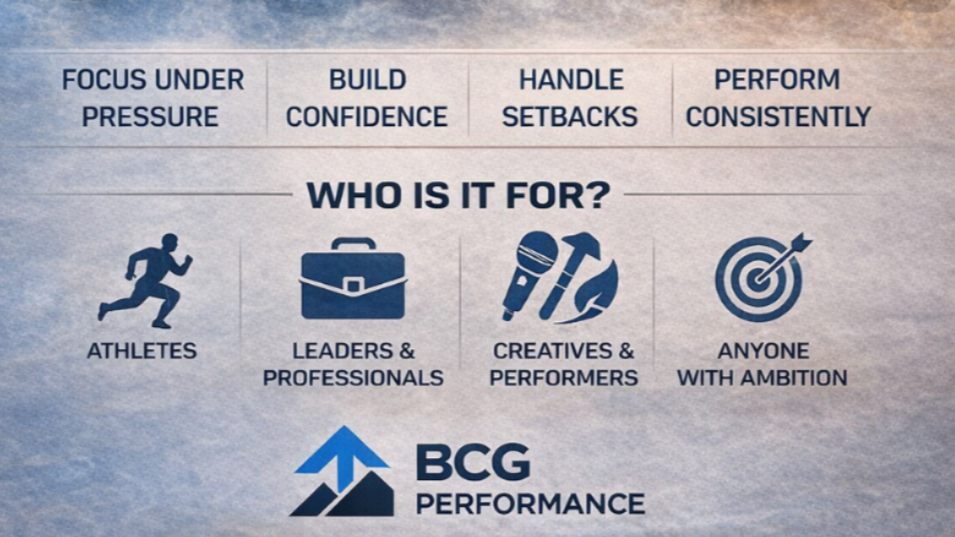
· Performing more consistently and not just on “good days”
· Managing nerves, stress, and pressure
· Improving focus and concentration
· Building confidence that’s stable rather than fragile
· Responding better to mistakes and setbacks
· Maintaining motivation and direction over time
· Clearer decision making
· Executing skills more effectively when it counts
Importantly, these aren’t traits you either have or don’t have. They’re skills that can be developed, practised, and strengthened over time.
Who Is Performance Psychology For?
One of the biggest misconceptions is that performance psychology is only for elite athletes or high performers at the very top.
In reality, it’s useful for anyone who wants to perform closer to their potential, more often.
That includes:
· Athletes at all levels
· Coaches and practitioners
· Business professionals and leaders
· Students and performers
· Creatives and freelancers
· Anyone navigating pressure, expectation, or high-stakes moments
You don’t need to be “struggling” to benefit. Many people use performance psychology not to fix problems, but to enhance what’s already working.
What Can Performance Psychology Enhance?
Performance psychology doesn’t replace technical ability, physical preparation, or experience, it amplifies them.
You might be physically prepared but struggle to access that ability under pressure. You might have strong knowledge but doubt yourself at key moments. You might train well but fail to reproduce it consistently.
This is where psychological skills come in.
They help bridge the gap between:
· Training and performance
· Ability and execution
· Potential and consistency
When psychological skills are developed intentionally, performance becomes less dependent on mood, confidence spikes, or external conditions and more within your control.
Following on from this post I am going to release a series on psychological skills; this series will explore and break down individual psychological skills one by one.
Each post will explore:
· What the skill is and what it’s used for
· How it influences performance
· Practical ways to start developing it
· How to refine and strengthen it over time
· Common misconceptions and mistakes
This series will make performance psychology practical, usable, relevant and something you can apply in your everyday life and personal and professional pursuits.
To get access to posts before they go live, join the subscriber mailing list.