
Imagine you are about to deliver an important presentation.
Five minutes before you walk into the room, your manager criticises a piece of work you've spent weeks preparing.
You don't argue, you don't lose your temper.
You smile and deliver an excellent presentation.
Afterwards, you're exhausted. But the presentation wasn’t physically demanding.
So where did the fatigue come from?
Every emotion has a cost
All emotion regulation strategies require mental effort.
Whether we’re redirecting attention, suppressing an emotional response or reappraising a situation, we’re using attention, working memory and self control.
Emotion regulation is a performance task in itself.
Cognitive load - The hidden cost of staying composed
Imagine you are driving up a steep hill in a car towing a trailer. This car represents your ability to perform. Every emotional event that requires regulation adds more weight to the trailer. Each addition of weight increases the effort required to maintain the same speed going uphill. The car can still move forward, but as the weight in the trailer increases, so too does the amount of fuel required to pull the car uphill. Eventually, the trailer becomes so heavy that simply maintaining the same speed requires considerably more effort.
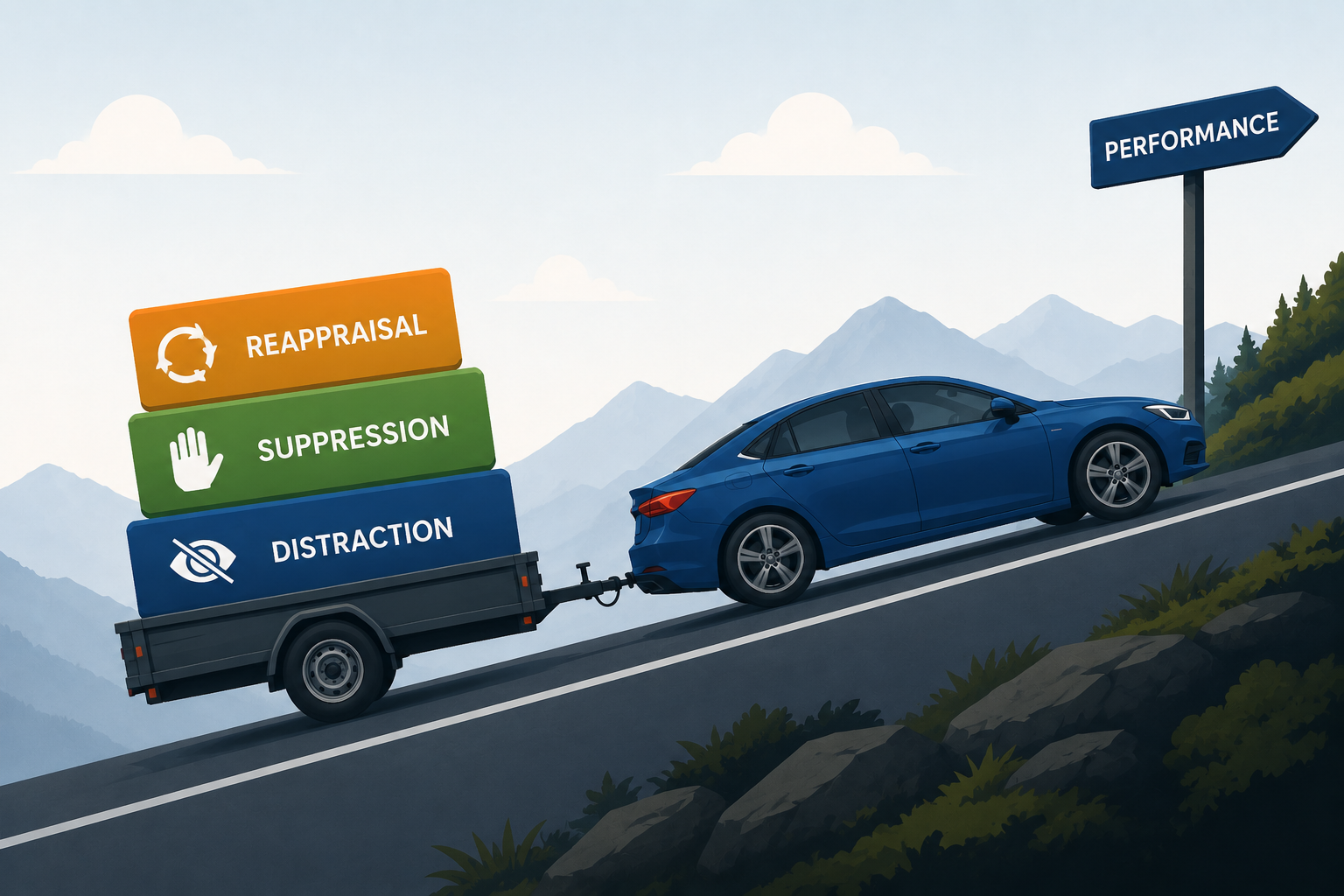
When the trailer becomes too heavy
Eventually the additional cognitive effort begins to affect our performance:
Slower decision making which can in turn lead to poorer decisions under pressure
Concentration becomes harder to maintain over prolonged periods
Slower reaction times
Tasks begin to feel more effortful than they otherwise would
Reduced self control
Though all of this is going on, we can, and often do still look perfectly composed to the outside world.
Sport
A footballer taking an important penalty may look perfectly composed to the outside world, but is likely already under considerable cognitive fatigue as a result of the constant regulation required to perform in competition. Add to that the pressure of taking an important penalty or making important decisions throughout the game, and they are likely to feel mentally as well as physically exhausted at the end of the match.
Military
Military personnel on prolonged operational deployments are required to maintain their composure in high-pressure situations and, coupled with being away from family and friends, often require a period of decompression upon return to recover from the prolonged increase in cognitive fatigue through emotion regulation in intense environments.
Leadership
A leader that is managing conflict and making decisions all day that will impact their team that they are also trying to manage will often find themselves feeling exhausted by the end of the day from the cognitive load that has been encountered, despite being sat at a desk all day.
Coaching
A coach will have to repeatedly regulate their emotions while simultaneously coaching multiple athletes, providing personalised feedback to enhance their athletes’ performance and manage the training drills, all of which require constant regulation of their own emotions and an awareness of and engagement with their athletes’ emotions.
The leadership trap
Sometimes what appears to be a lack of motivation, poor decision-making, or disengagement may actually be the effects of cognitive fatigue following prolonged emotion regulation or particularly intense emotional demands.
As coaches and leaders, we often judge performance by what we can see. If someone appears distracted, makes an uncharacteristic mistake or lacks energy, our first instinct may be to question their commitment or capability. But before we do, it's worth asking another question:
What have they been carrying cognitively up until this point?
Understanding the hidden demands of emotion regulation encourages us to become more curious before we become critical.
What does this mean for coaches and leaders?
Recognising the cognitive cost of emotion regulation has practical implications for anyone responsible for developing or leading others.
Rather than assuming poor performance is always a result of low motivation or inadequate preparation, we should also consider the cognitive demands an individual has already been exposed to.
Has the athlete spent the morning dealing with selection uncertainty before stepping onto the pitch?
Has a member of your team just come out of a difficult conversation before asking them to make an important decision?
Has a coach been regulating their own emotions while supporting multiple athletes throughout the day?
Sometimes performance doesn't deteriorate because people don't care.
Sometimes it deteriorates because they've already spent a significant proportion of their cognitive resources simply staying composed.
Designing for performance
If emotion regulation consumes cognitive resources, then one of the most effective ways to enhance performance is to reduce unnecessary cognitive load before it matters most.
This begins long before competition or a high-pressure meeting.
Emotion regulation can be trained through repeated exposure to manageable emotional challenges. By creating psychologically safe environments where individuals can experience setbacks, reflect on their responses and practise reappraisal, coaches and leaders can gradually increase an individual's capacity to regulate increasingly intense emotions.
Over time, this repeated practice can also make emotion regulation more efficient. Situations that once required significant mental effort become easier to manage, reducing the cognitive resources required for regulation and leaving more capacity available for performance itself.
Preparation also matters.
Predictable routines reduce uncertainty and allow individuals to anticipate situations before they occur, reducing the amount of regulation required in the moment. Carefully considering the timing of emotionally demanding conversations, critical feedback, or conflict can also help preserve cognitive resources for tasks that require concentration and high-quality decision-making.
Imagine delivering difficult performance feedback immediately before asking an athlete to perform under pressure. The feedback itself might be valuable, but it also creates an additional emotional demand that the athlete now has to regulate. By simply changing when that conversation happens, we may preserve cognitive resources for the performance that follows.
The goal isn't to remove pressure.
The goal is to ensure that the pressure people experience is productive rather than overwhelming.
Key takeaway
We often think of fatigue as something that comes from physical effort. But some of the greatest demands on performance are invisible.
Every difficult conversation, frustrating setback and emotional response we choose to regulate consumes cognitive resources.
The less effort emotion regulation requires, the more cognitive capacity remains for the task that matters most.
Perhaps the greatest performance enhancer isn't always asking people to try harder. Sometimes it's reducing what they're having to carry.