
We all regulate our emotions, whether we realise it or not
Have you ever been cut up in traffic by someone who seemed to be going too fast or simply wasn't paying attention?
Your first instinct might be to honk your horn or shout in frustration. Then a few seconds later another thought enters your mind, "maybe they're rushing to an emergency". Almost instantly your frustration passes and you carry on with your journey. On another day, you might choose to ignore the other driver completely and continue the conversation with your friend in the passenger seat. In both situations, you've regulated your emotions, often without even realising it.
Everyone regulates emotions every day. The real question isn't whether we regulate them, but how
Sometimes we change what we're paying attention to. Sometimes we hide what we are feeling. Other times we change the way we interpret the situation altogether.
James Gross' Process Model of Emotion Regulation groups these into a number of common regulation strategies. While each has its place, research suggests that they don't all produce the same outcomes.
Broadly speaking, we tend to regulate our emotions in three ways. We can redirect our attention away from the situation, supress what we're feeling or expressing, or reappraise the situation by changing how we interpret it. Each strategy can be useful, but their effectiveness depends on the situation and the goal we are trying to achieve.
At first glance, it might seem like the goal is to identify the best emotion regulation strategy. However, the evidence suggests that rather than relying on one strategy all the time, effective emotion regulation depends on developing the flexibility to choose the right strategy for the demands of the situation.
Distraction - What is it?
Distraction involves deliberately shifting your attention away from the emotional stimulus. This can be active, intentionally thinking about something else or passive, completing a distracting task like watching television.
When is it useful?
Immediately after an emotionally overwhelming event
When emotions are so intense that engaging with them productively isn't yet possible.
Limitations
Distraction can provide short term relief, but if it becomes our default emotion regulation response it can prevent us from processing and learning from situations requiring regulation.
Often if the emotional intensity of a situation is higher than a person is used to coping with, they will revert to the regulation strategy they have previously had the most success with. One way of thinking about this is that when emotional intensity exceeds an individual's current regulation ability, they are more likely to fall back on strategies that have previously provided immediate relief.
An example of this is when a colleague is under a lot of pressure to complete an important piece of work or several important pieces, if this situation becomes emotionally intense for them, you may find them distracting through completing other tasks instead.
Implications for coaches and leaders
If someone consistently relies on distraction, it may indicate that they're not yet equipped to engage with emotions at that level of intensity.
Rather than criticising their behaviour, coaches, leaders and teams should consider whether the emotional demands of a situation are exceeding their current regulation ability.
Suppression - What is it?
Suppression involves either suppressing your emotional response to a situation, like a coach or player not outwardly expressing their anger when they disagree with a referees decision.
Alternatively it can involve suppressing the experience of emotion or thoughts of the emotion eliciting event.
When is it useful?
Like the example above, suppression of our expression of emotions is often useful and used frequently throughout each day as we interact with other people and the world around us and is more often than not used to stay on the side of remaining socially acceptable.
Limitations
Suppressing the expression of emotions can be extremely helpful in emotional situations like the coach and referee described above, but if this is continued over long term without subsequent active management it can become detrimental to wellbeing.
Research has also shown that suppression of the experience of emotions or thoughts of an emotion eliciting event may provide slight short term relief but long term reliance is associated with poorer wellbeing and relationships.
Implications for coaches and leaders
Suppression can be invaluable during performance or leadership situations where immediate emotional control is required.
However, it should be viewed as a temporary strategy rather than a long term solution.
Reappraisal - What is it?
Reappraisal is changing the interpretation of the emotion eliciting situation rather than avoiding the emotion itself.
It can also be used to change the interpretation of your response to a situation, however research shows this is less effective than changing the interpretation of the situation.
For example, receiving feedback can be difficult as it is often interpreted as an attack of our character or performance, but reinterpreting this to frame it as being positive and trying to help our development is a much more useful way of engaging.
When is it useful?
Reappraisal is consistently found to be the most effective strategy for emotion regulation, it is associated with increased resilience and wellbeing, and can be learned and improved upon as a strategy through training and use.
In the example above reappraisal helps to take the feedback and use it positively for your own personal development regardless of whether it was intended to offend or develop and as such allows you to control how a situation affects you emotionally.
Because reappraisal involves reflecting on a situation, it also presents a learning opportunity each time it is used as a strategy and helps us build patterns of use that will benefit us in the future.
Limitations
Because reappraisal requires reflection and thought to change the interpretation of a situation it can often take longer, which is why repeatedly practicing and training this strategy is useful to help minimise the time required.
Reappraisal also places greater cognitive demands on an individual. During high intensity emotional situations, it may therefore be difficult to use effectively.
However, with repeated practice and successful application across progressively more demanding situations, individuals may become increasingly capable of using reappraisal under greater emotional intensity.
Implications for coaches and leaders
This is why reappraisal is consistently associated with better wellbeing, resilience and performance. It doesn’t remove difficult emotions, it changes the meaning we attach to them, creating opportunities for regulation and learning.
Incorporating reflection into feedback sessions could help individuals engage with reappraisal practices to enhance this strategy and increase resilience.
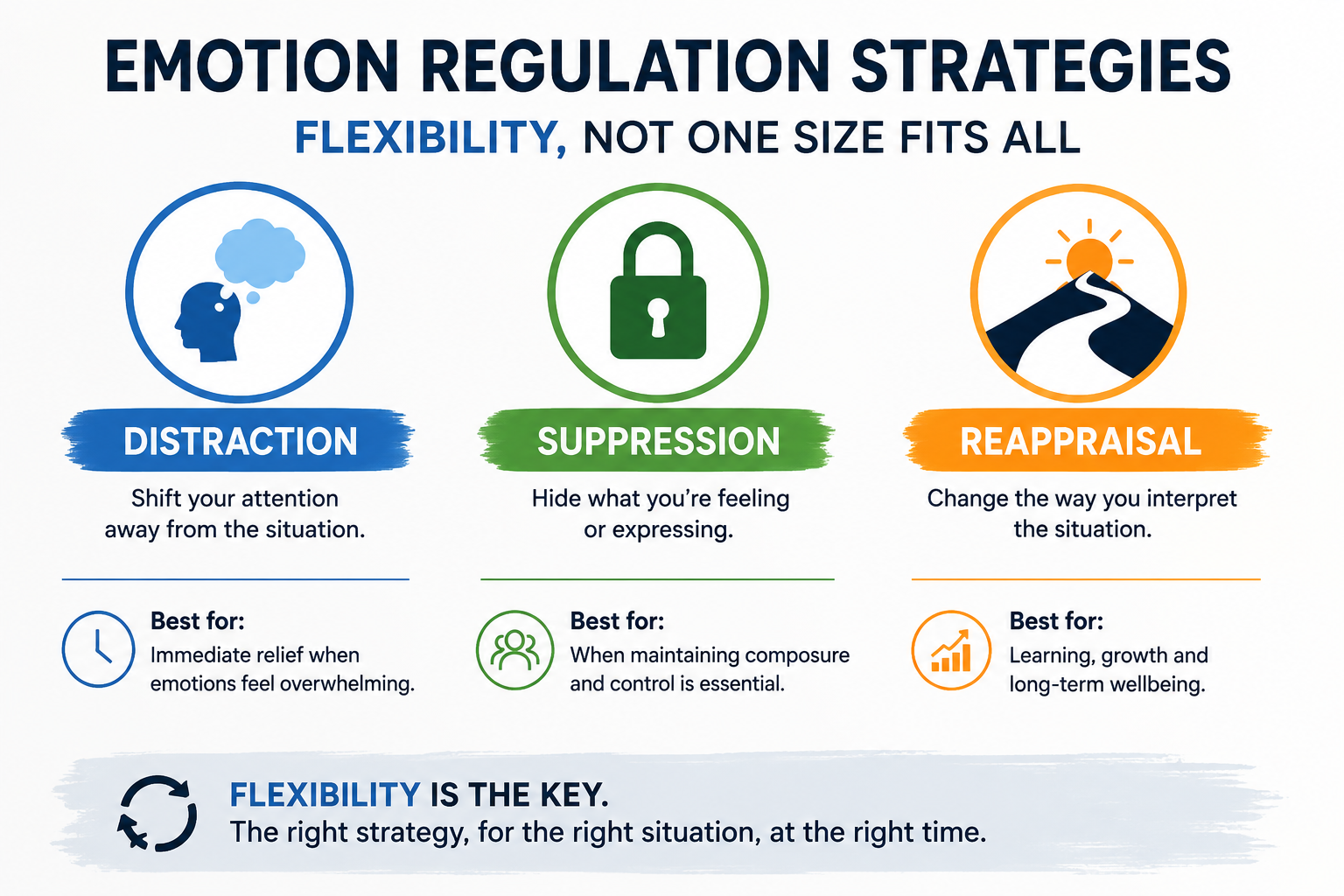
Every strategy has its place and a purpose, but not every strategy is equally effective in every situation. Knowing you can use each strategy effectively and then being able to choose the most appropriate strategy is what provides the greatest benefits.
If flexibility is the goal, then the obvious question is whether it can be developed.
Can emotion regulation be trained?
The good news is that one of the most consistent findings in emotion regulation research is that these coping strategies are not fixed. Like any other skill, emotion regulation can be developed through deliberate practice. The goal, therefore, shouldn't be to eliminate difficult emotions, but to gradually increase our ability to regulate increasingly intense emotional experiences.
For coaches and leaders, this has important implications.
Rather than creating an environment designed to protect individuals from emotionally demanding situations, or overwhelming them with challenges they aren't yet equipped to deal with, we should aim to create environments where emotional demands increase progressively, allowing successful regulation strategies, particularly reappraisal, to be reinforced over time.
This doesn’t mean exposing people to unnecessary stress.
It means creating appropriately challenging environments where individuals can experience difficult emotions, practise effective regulation strategies, where help is available, and gradually build confidence in their ability to cope
Through doing this, we aren't just teaching people how to regulate emotions; we are helping them to build resilience.
Key takeaway
We often think resilience comes from experiencing difficult emotions. The evidence suggests it may come from repeatedly learning how to regulate those emotions successfully.
Effective emotion regulation isn't about finding one perfect strategy. It's about developing the flexibility to choose the right strategy for the demands of the situation.